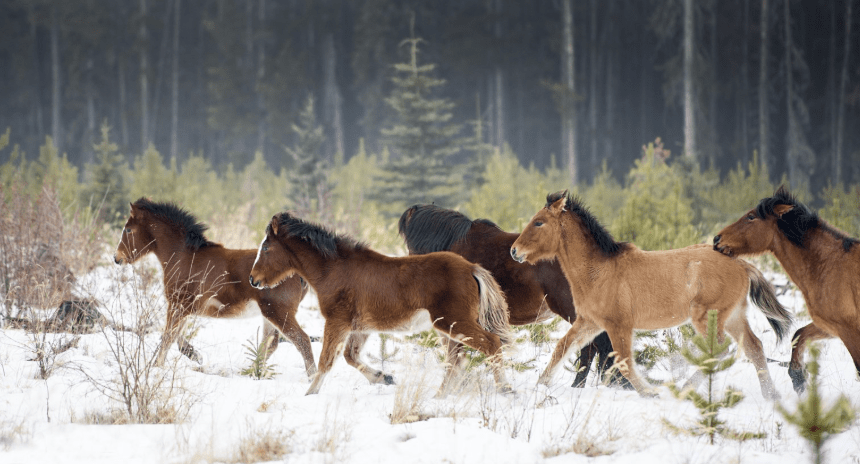
Around the world, wild horses and feral horses play an important role in ecosystems and cultural traditions. While they are sometimes controversial due to competition with livestock or wildlife, they also embody resilience and freedom, drawing attention to the need for sustainable land management. One fascinating example can be found in Canada.
Case Study: The Wildies of Canada
Scattered across thousands of square kilometers of the foothills and grasslands of Alberta, British Columbia and Saskatchewan, are small bands of wild horses. The wild horses, or “Wildies” and ferals* as some call them, are mixed breeds of ancient North American equines or other breeds brought to Canada by the Spanish and Iberian settlers. They are now the beating heart of the wild and are a symbol of resilience, freedom and culture in Canada.
These wildies are deeply interconnected with Canada’s history, even though you don’t see them in the average history textbook. Early European settlers and indigenous communities used them as a means of transport, hunting and survival. Even today, indigenous groups preserve this memory and believe that horses hold a spiritual connection to the land, representing strength and harmony. They continue to inspire art, literature, and local pride, serving as living reminders of Canada’s cultural heritage.
Did you know that their presence also has huge benefits? They graze on shrubbery and wild plants, making their feces highly nutritious to the soil. Their grazing habits also clear natural pathways through forests and vegetation, helping maintain ecosystems and create open spaces for birds and small mammals. However, they do pose some challenges. They sometimes compete with cattle or native wildlife for resources, raising questions about how to balance conservation with agricultural needs.
Unlike deer or bears, wild horses in Canada are not officially recognised as wildlife, which makes protecting them difficult. Some herds face roundups or culls, sparking debate between ranchers, conservationists, and local communities. But what can we do? Many believe culling is cruel and unnecessary, so do I. There are more humane management methods, such as contraception, which helps manage population size, and adoption programmes, which encourage people to foster them on private property, protecting them and maintaining herd sizes.
One might ask, why does this matter? Well, the Canadian wildies remind us that conservation is not only about preserving endangered species, but also about honouring the relationships between people, animals, and landscapes. Protecting them demonstrates how cultural identity and ecological balance can coexist, making them a powerful symbol of sustainable life on land.
*A point to note is that these horses are not indigenous to North America but are an invasive species that adapted to the wild environment after being abandoned or escaping from humans, that is why they are called feral horses. The horses in Canada are feral, meaning they are descended from domesticated animals that have returned to a wild state.


 Echoes Of The Hooves
Leave a comment